

Review · CHRIST THE REDEEMER STATUE & CORCOVADO TOURS
Rio in Style: A Journey Thru Corcovado, Sugarloaf, Selaron
Rio hits you fast. In one long morning, you get Corcovado viewpoints, Sugarloaf panoramas, and Rio’s color at Selaron. It’s built as a whistlestop route with a guide to keep you moving, plus a real backup if clouds hide the summit.
I love the timing. You start early, which helps you reach Christ the Redeemer and Sugarloaf ahead of the big crush, so your photos are calmer and your headspace is clearer. I also love that the day is organized around guided stops like Escadaria Selaron and the Lapa area, so you spend less time figuring out transit and more time looking.
One thing to plan for: the big-ticket sights cost extra. Corcovado and Sugarloaf entrance fees are not included, and Sugarloaf may also involve extra payment for the cable car, so budget a bit beyond the $97 price.
Key things you will notice on this Rio tour
- Early morning start that reduces line stress at Christ the Redeemer and Sugarloaf
- Backup plan for clouds, usually Mirante Dona Marta if Corcovado is hidden
- Small group size (max 14), so your guide can actually keep track of everyone
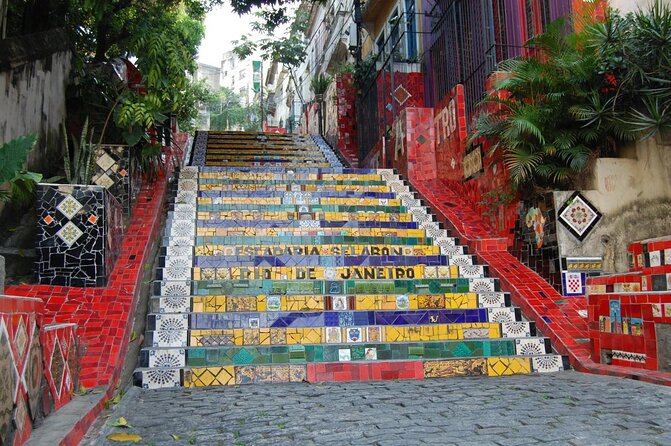
- Selaron Steps detail, including 215 steps and thousands of collected tiles
- A full highlight mix, from Ipanema and Lapa to Tijuca Forest and monastery stop
Why This Rio in Style Day Works for First-Time Sightseers

This tour is designed for one specific mission: get your bearings in Rio without burning your day on transit, wrong turns, or hunting tickets. You cover beaches, downtown neighborhoods, and two of Rio’s most famous viewpoints in one stretch, with an air-conditioned minivan doing the heavy lifting between stops.
The value is in the structure. Instead of you piecing together routes and timing, you follow a guide who has the day’s flow in mind. That matters because Rio is spread out, and the famous viewpoints are where time evaporates if you arrive late.
You should also like the pacing. It is not a slow, sit-and-stare tour. It is more like guided highlights with enough time at each key spot to see, take pictures, and move on.
Getting Picked Up in Copacabana, Then Moving Like a Pro
Most days start at 7:00 am from the Hilton Rio de Janeiro Copacabana on Av. Atlântica in Copacabana. The tour ends back at that same starting point, so you keep your day simple.
If your hotel is one of the selected pick-up addresses, you get hotel pickup and drop-off. If not, you go to the meeting point. Either way, you are traveling in an air-conditioned minivan, which is a big deal in Rio’s heat.
The group stays small, up to 14 people. In real life, that means fewer “where is everyone?” moments. It also means your guide can do practical things, like keeping time, herding the group back together after viewpoints, and even helping with photos.
One practical note from the vibe of the day: because you leave early, you may want to eat breakfast quickly back at your hotel. There have been days when people skipped breakfast because the morning starts so soon.
Ipanema and Copacabana, the Beach Intro You Need
Before you start climbing to viewpoints, you get a beach orientation. You pass Ipanema, the stretch between Arpoador on one side and Leblon on the other. This area is known for its activity and for being one of Rio’s pricier neighborhoods, with lots of wealthy residents and a very “Rio” social feel.
Then the tour starts from Copacabana Beach. Copacabana is famous for a reason. It is one of those places where you can immediately understand why artists and photographers obsess over Rio’s coastline.
Even if you have already seen photos online, standing at the shoreline with the guide talking helps you connect the dots. You start to recognize how different neighborhoods line up toward the water and toward the hills.
Morro da Urca and Sugarloaf, the Views That Just Make Sense

The day’s first real climb takes you to Morro da Urca, a low hill that still delivers huge payoff. From the top, you look out over Botafogo and Flamengo beaches, across toward Corcovado, and into the shape of Guanabara Bay. You can even spot landmarks like Santos Dumont Airport, Governador Island, and the Rio-Niterói Bridge in the wider mix of the city.
Then comes Sugarloaf Mountain itself. At 396 meters high, it is one of the best places to understand Rio’s geography. From up there, you see how the city hugs water, how the hills frame neighborhoods, and how far the views stretch.
Tickets and the one extra cost to watch
This is where you need to pay attention. The tour price does not include the Sugarloaf admission fee. On the pricing sheet, Sugarloaf is listed as $35.00 per person not included.
And in practice, some people also end up paying extra for the cable car ride. One group reported paying around 80 Brazilian reais per person for the cable car to reach the Sugarloaf side. So I strongly suggest you confirm early in the day what you are already covered for, and what is still pay-at-the-spot.
If you qualify for senior discounts, bring picture ID. One traveler ran into a scramble around discount requirements, and it is the kind of detail that can save you embarrassment.
Lapa Aqueduct, Historic Palace Views, and Getting Oriented in Downtown

As you head through central Rio, you hit a classic Lapa moment: the Carioca Aqueduct, also called Arcos da Lapa. It is a historic structure in the city center, and it matters because it is not just a pretty leftover. It still serves as a working passageway for a tram connection that climbs toward Santa Teresa.
You also pass by a historic neoclassical palace tied to the imperial era. The tour describes it as built around the 1850s for merchant Machado Coelho, later acquired by the imperial government in the 1860s connected to Princess Isabel and the Count of Eu, and then moving through republic-era confiscation and restorations. Even from the outside, it is the kind of stop that gives the downtown a storyline.
Downtown Rio can feel chaotic if you are on your own. With a guide, it becomes a set of named places with context, not just streets.
Escadaria Selarón, the Cathedral Stop, and Why These Tiles Matter
Then you get to one of Rio’s most instantly recognizable scenes: the Escadaria Selarón, the Selarón Steps. This tiled staircase connects Lapa and Santa Teresa, and it is the work of self-taught Chilean artist Jorge Selarón, who moved to Rio in 1983 and lived right by the stairs.
This is not “just a photo spot.” It has a human backstory. The staircase has 215 steps, and Selarón covered it with tiles collected across Rio and from visitors around the world. Since 1990, the count has grown past 2,000 tiles, with dominant colors green, yellow, and blue that echo the Brazilian flag. People even link it to music video appearances.
If you like street art, this stop will give you more than a quick look. Take time here. The tiles have differences, repairs, and layers that you only notice when you slow down.
The Metropolitan Cathedral of Saint Sebastian, plus one real-world heads up
Next you visit the Metropolitan Cathedral of Saint Sebastian, a cone-shaped modern landmark. The design is inspired by Mayan pyramid ideas, and the guide notes the acoustics are excellent. Stained glass windows run floor to ceiling and create a cross shape near the top.
One caution: some days the cathedral can be closed due to local events. If it happens while you are there, you may not see everything you expect. It is not something you can control, but it helps to have the right mindset, this day is built for highlights, not museum-grade certainty.
Tijuca Forest and Corcovado, the Morning Climb That Changes Everything
The climb toward Christ the Redeemer runs through Tijuca Forest, the tropical rainforest inside Rio. The tour frames it as a small but significant portion of the city area, and it gives you perspective on how Rio can feel wild and urban at the same time.
You stop at Paineiras to board official vehicles for the climb to Corcovado. This is one of those logistics points where you really do benefit from having a guide, because you are not trying to figure out how to get up the hill efficiently.
Christ the Redeemer, the details you will remember
At the summit, you see Christ the Redeemer. The tour description highlights that the statue stands 38 meters tall, made of reinforced concrete and clad in a mosaic of thousands of triangular soapstone tiles.
You can also enjoy a sweeping view of the city. This is where you stop thinking about a checklist and start seeing how Rio lays out across bay, hills, and neighborhoods.
Backup plan when clouds cover Corcovado
If visibility is poor at the summit, the tour swaps in a backup viewpoint: Mirante Dona Marta (also listed around 362 meters). It generally avoids the worst cloud cover, and the guide is prepared for it.
That matters because Corcovado is famous, but it is also famous for clouds. Having a built-in alternative means you do not lose the entire payoff.
Mosteiro de São Bento and the Golden Church Moment
Near the end of the route, you visit Mosteiro de São Bento, described as the oldest monastery in Rio with a Golden Church. This is a quieter contrast to the big viewpoint stops, and it helps break up the day so it does not feel like constant driving and crowds.
If you like architecture and religious art, this can be a satisfying final “watch your step, slow down” moment.
Maracanã and the Carnaval Parade Stadium Area, Seeing Rio the Sports and Music Way
The tour also includes passes by Rio’s major stadium landmarks. The stops are described as the most famous stadium in the world and the Carnaval parade stadium.
Think of these as looks and positioning more than long visits. The point is that you get the geographic context for where Rio’s biggest public events happen, especially if you plan to experience samba music or a show during your stay.
What You Pay, What You Actually Get, and Where the Value Shows
Let’s talk money, in plain terms.
Your tour price is $97.00 per person and it includes a professional guide, a ride in an air-conditioned minivan, and hotel pickup and drop-off for selected hotels. You get the guided structure, the small-group pacing, and the backup plan for clouds.
Not included:
- Corcovado entrance (Christ the Redeemer): $20.00 per person
- Sugarloaf entrance: $35.00 per person
- Lunch is listed as not included, though you do get time to eat and the guide will point you to restaurant options
In total, if you only add the two listed entrance fees, you are already at about $152 before any extra spending. Then add likely extra costs for cable car usage at Sugarloaf if your ticket setup requires it.
So is it worth it? For many people, yes, because you are paying for time management. Christ and Sugarloaf are the two spots where lines and timing can wreck your day. The route also bundles in multiple neighborhoods and icons like Escadaria Selarón and Lapa aqueduct, which would take multiple separate outings if you are planning on your own.
Where this tour becomes less good value is if you expect everything to be included end-to-end without extra payments at the viewpoints. The tour clearly separates guide and transport from entrances. If you want a one-price, no-surprises day, you have to confirm what your exact ticket covers for cable car rides and discount requirements.
Tips to Avoid the Common Friction Points
Here are the practical steps I’d take if I booked again.
First, confirm tickets at the start of the day. Ask your guide what is already included versus what you pay on-site for Corcovado and Sugarloaf.
Second, bring picture ID. Some discount rules can require ID at the gate.
Third, bring water. Rio can be brutally hot. One traveler noted a day at about 41C, and the simplest fix is planning hydration from the start.
Fourth, wear shoes you can walk in. You will be moving between viewpoints, stairs, and outdoor stops. Selaron is steps, not a gentle stroll.
Finally, keep your day flexible in your head for closures. The cathedral has been closed on at least one departure due to local factors, and the guide may adjust how the day plays out.
Should You Book Rio in Style for Your Day in Rio?
Book it if you want a guided day that ticks off Rio’s biggest hits, you are short on time, and you want help getting your bearings fast. This is especially smart for a first visit, for cruise travelers, or for anyone who would hate spending half a day untangling bus routes and cable car schedules.
Skip it or choose another option if your number one goal is a fully inclusive price with no extra payments at viewpoints, or if you strongly prefer slow museum time over getting to multiple neighborhoods.
If you do book, the biggest win is the combination of early sightseeing, the backup viewpoint for clouds, and the fact that Selaron plus downtown stops give you real neighborhood texture, not just postcard photos.
FAQ
What time does the tour start, and where do I meet?
The tour starts at 7:00 am. The meeting point is Hilton Rio de Janeiro Copacabana, Av. Atlântica, 1020, Copacabana, Rio de Janeiro, RJ 22010-000, Brazil. The tour ends back at the meeting point.
Does this tour include hotel pickup and drop-off?
Hotel pickup and drop-off are included for selected hotels only. If your hotel is not selected, you will likely need to meet at the main starting point.
What is included, and what costs extra?
Included are a professional guide, hotel pickup and drop-off (selected hotels only), and transport by air-conditioned minivan. Not included are entrance tickets to local attractions, plus the Corcovado and Sugarloaf admission fees, and lunch.
How much extra should I budget for Corcovado and Sugarloaf?
Corcovado – Christ the Redeemer is listed as $20.00 per person not included. Sugarloaf Mountain is listed as $35.00 per person not included.
What happens if Corcovado is obscured by clouds?
If visibility on Corcovado is poor, the tour makes an alternative stop at Mirante Dona Marta. It is generally less affected by cloudiness.
Can I cancel for free?
Yes. There is free cancellation. You can cancel up to 24 hours in advance of the experience start time for a full refund.
More Time on the Escadaria






Still on Sugarloaf? More Cable-Car Trips





Corcovado, Other Ways Up


Christ the Redeemer Statue & Corcovado Tours, compared.
 ★ 4.4Christ the Redeemer Entry Ticket by Corcovado TrainFrom $454,476 reviews
 ★ 4.5Rio: Christ the Redeemer, Sugarloaf, Selaron & BBQ LunchFrom $692,428 reviews
 ★ 4.7Christ, Selaron Steps, and Tijuca Park TourFrom $68857 reviews
 ★ 4.0Skip the Line to Christ Redeemer, Sugar Loaf and Barbecue LunchFrom $113593 reviews
 ★ 4.0Skip the Line Christ the Redeemer Admission TicketFrom $45508 reviews
 ★ 4.6Christ the Redeemer and Sugarloaf Tour with…From $141499 reviews
 ★ 4.4Rio: 5-hour Christ the Redeemer and Sugarloaf Express TourFrom $109407 reviews
 ★ 4.8Rio: Christ the Redeemer Early Access and SugarloafFrom $125404 reviews